
In many small and medium-sized industrial companies, automating the end-of-line is perceived as a large and complex investment.
However, automation does not have to happen all at once. There are strategies that allow automation to be implemented in phases, adapting the investment pace to the company’s capacity.
Progressive automation is a smart way to grow: it allows companies to start with basic equipment and evolve towards a fully connected line, without having to replace what is already installed.
IHRESS supports SMEs along this path, offering scalable, cost-effective, and sustainable solutions.
1. What is progressive automation
Progressive automation consists of implementing automation in stages, according to the company’s priorities and resources.
For example:
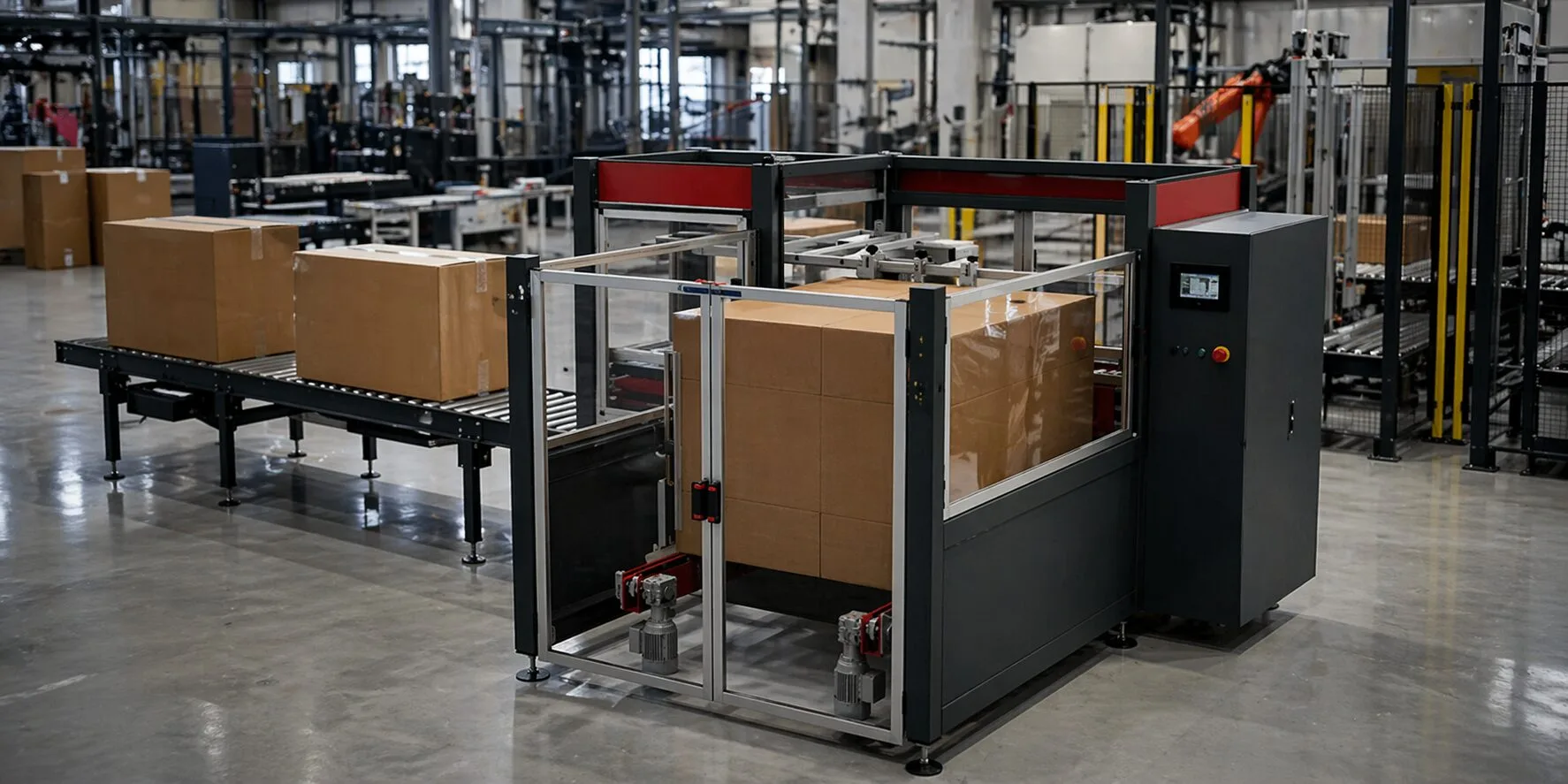
- Phase 1: add an automatic case sealer.
- Phase 2: add a strapping machine or wrapper.
- Phase 3: integrate a palletizing robot.
- Phase 4: connect all equipment through a centralized control system.
Each step provides immediate benefits and prepares the ground for the next one.
The goal is to move towards an integrated and efficient line without interrupting production or taking on high initial costs.
2. Advantages for industrial SMEs
Advantages for industrial SMEs
SMEs can spread the investment over time, prioritizing areas with the highest return.
This reduces financial impact and improves budget planning.
Progressive performance improvement
Each new machine or integrated module increases productivity and reduces manual errors, delivering visible results from the first phase.
Flexibility to adapt to change
The industrial market evolves quickly. A modular line allows adaptation to new products or volumes without rebuilding the entire installation.
Lower operational risk
Step-by-step automation makes it easier to evaluate results and adjust the strategy before moving to the next phase.
Higher medium-term profitability
Each improvement increases energy efficiency, reduces waste, and improves operator safety.
Return on investment accelerates as automation progresses.
3. How to plan step-by-step automation
The success of a progressive project depends on solid technical planning.
IHRESS recommends the following approach:
- Initial diagnosis: analyze bottlenecks, downtime, and operating costs.
- Define phases: determine which processes to automate first based on impact.
- Select modular technology: compatible and scalable equipment.
- Gradual integration: connect new machines as they are added.
- Monitor results: measure savings, productivity, and energy consumption.
This method ensures that each investment translates into real, measurable improvements.
4. Practical example of progressive automation
A company in the food sector started by automating only the case sealing process.
After verifying reductions in time and errors, it added an automatic wrapper and later an IHRESS palletizing robot.
In less than two years, it achieved:
- 35% reduction in end-of-line time
- 25% increase in production capacity
- 25% increase in production capacity
Today, its line operates in a synchronized and connected way through a SCADA system, demonstrating that progressive automation is a viable and profitable strategy for any SME.
5. The importance of choosing a technology partner
To automate in phases, it is essential to work with an integrator that understands the plant’s long-term evolution.
IHRESS offers:
- Scalable modular line design
- Compatibility with both proprietary and multi-brand equipment
- Centralized control software integration
- Continuous technical support
In this way, each investment becomes part of a global plan that ensures technical consistency, energy savings, and sustained growth.
6. Conclusion: grow step by step without stopping production
Progressive automation allows SMEs to modernize their processes without compromising financial stability.
Each phase is a tangible improvement that brings the company closer to a fully integrated and digitalized line.
With IHRESS’s modular approach and engineering, SMEs can confidently move toward more efficient, connected, and competitive production.
Frequently Asked Questions (FAQs)
WHAT IS PROGRESSIVE AUTOMATION?
It is a model that allows automation to be implemented in phases, adapting investment and pace to each company’s needs.
WHY IS IT IDEAL FOR INDUSTRIAL SMEs?
Because it improves productivity and reduces costs without requiring a large initial investment.
Can existing equipment be combined with new automated modules?
Yes, as long as a scalable and compatible integration is properly planned, such as the one offered by IHRESS.
HOW LONG DOES IT TAKE TO SEE ROI?
Typically between 12 and 24 months, depending on the type of line and level of automation.
WHAT SUPPORT DOES IHRESS OFFER SMEs IN THIS PROCESS?
Technical consulting, phase planning, multi-brand integration, and continuous support at every stage of automation.
Do you want to automate your plant step by step?
IHRESS te ayuda a planificar una automatización progresiva adaptada a tu ritmo de crecimiento y presupuesto.
IHRESS helps you plan a progressive automation strategy tailored to your growth pace and budget.
Start with one improvement today and move toward the complete line of tomorrow.