
For many years, industrial automation —especially palletizing robots— has been associated with a common concern among operators on the shop floor:
“If a robot is introduced, someone might lose their job.”
However, in most real-world projects, the reality is very different.
Palletizing automation is not about replacing operators. It is about removing repetitive, physically demanding, and low-value tasks — allowing people to focus on more valuable activities.
In this article, we explain how collaborative robots and palletizing systems are transforming work on the shop floor without displacing human teams.
If you are considering automating this part of your line, having a prior analysis of the process can help you make better decisions from the very beginning.
1. The real challenge: repetitive tasks and physical strain
Manual palletizing is one of the most physically demanding tasks on the shop floor. It typically involves:
- Repetitive movements
- Manual handling of loads
- Awkward working postures
- Continuous pace over long shifts
This often results in:
- Accumulated fatigue
- Musculoskeletal injuries
- Sick leave
- High staff turnover
This is not just a productivity issue — it is a sustainability issue for day-to-day shop floor operations.
In many palletizing automation projects, this is the starting point for improving both efficiency and working conditions.
2. What a palletizing robot brings to daily operations
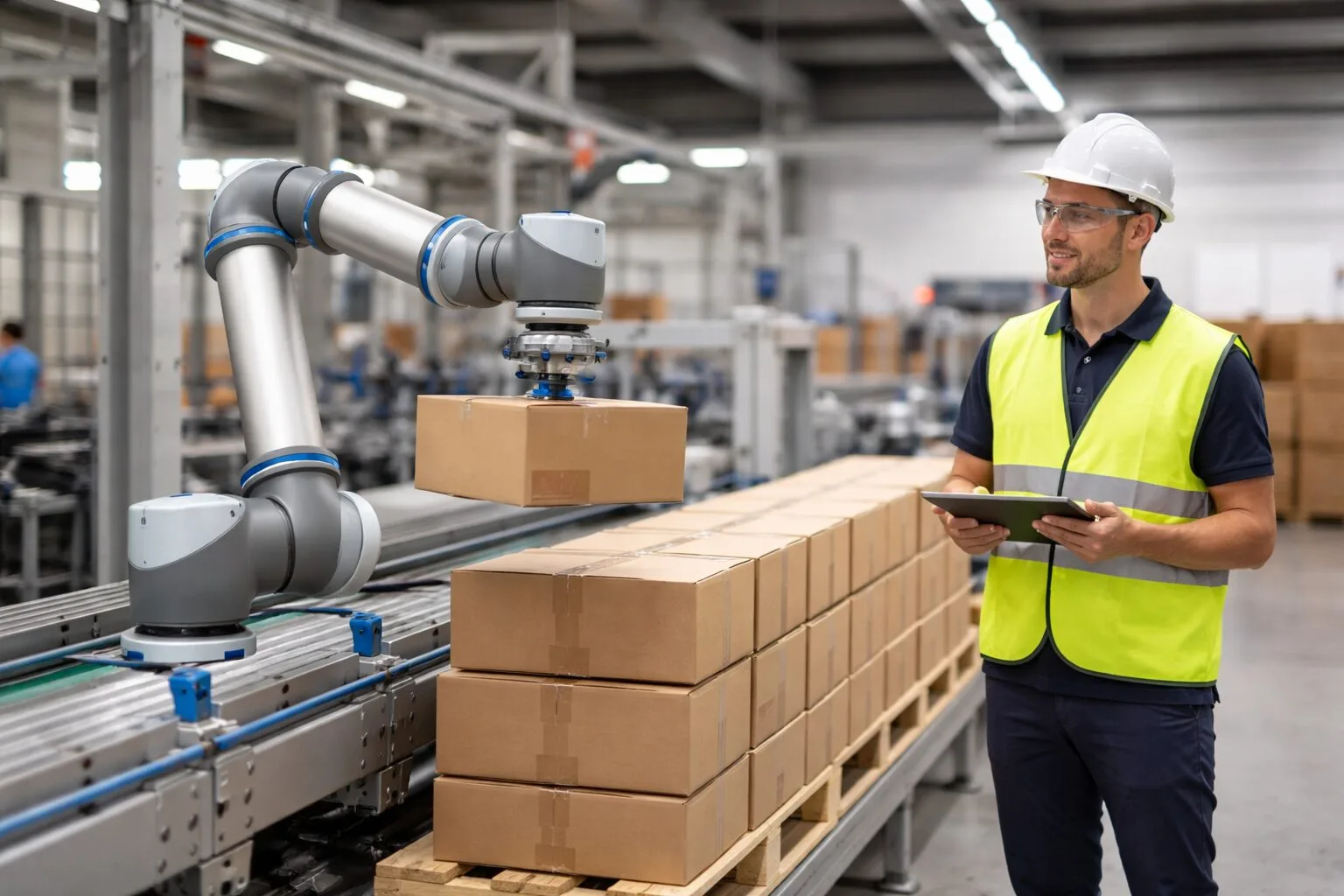
When a robot —especially a collaborative robot (cobot)— is introduced, the operator is not removed. Instead, their role evolves.
The robot takes care of:
- Lifting and handling loads
- Repetitive movements
- Maintaining a consistent pace
- Executing precise palletizing patterns
Meanwhile, the operator shifts to:
- Supervising the process
- Managing incidents
- Ensuring quality control
- Coordinating the production line
This transition moves the role from repetitive manual work to technical supervision and control.
At IHRESS, these types of solutions are designed to adapt to the real operations of each facility — not the other way around.
3. Fewer errors, smoother operations
One of the less visible —but most important— benefits is the reduction of errors.
Manual palletizing processes often lead to:
- Incorrect pallet configurations
- Load instability
- Stops caused by human error
- Variability in execution
A robotic system provides:
- Consistent precision
- High repeatability
- Stable process performance
The result is fewer disruptions and a smoother, more reliable production flow.
If your line experiences frequent stoppages or variability in palletizing, analyzing this process is usually the first step toward optimizing it.
4. The operator’s role evolves — it does not disappear
In practice, automation changes how operators work:
In practice, automation changes how operators work:
- Continuous manual handling of products
After automation:
- Supervising the system
- Intervening when necessary
- Focusing on higher-value tasks
Operator expertise remains essential.
The difference is that:
- Physical strain is reduced
- Ergonomics are improved
- Productivity increases
5. Real impact on the business
From a management perspective, palletizing automation delivers:
- Greater operational stability
- Reduced sick leave and absenteeism
- Improved working conditions on the shop floor
- Increased productivity
- Lower dependency on manual, repetitive tasks
This is not just an investment in machinery — it is an investment in efficiency and people.
Assessing the real impact of these types of solutions on your line can help you justify the investment with data, not just assumptions.
6. Collaborative robots: the balance point
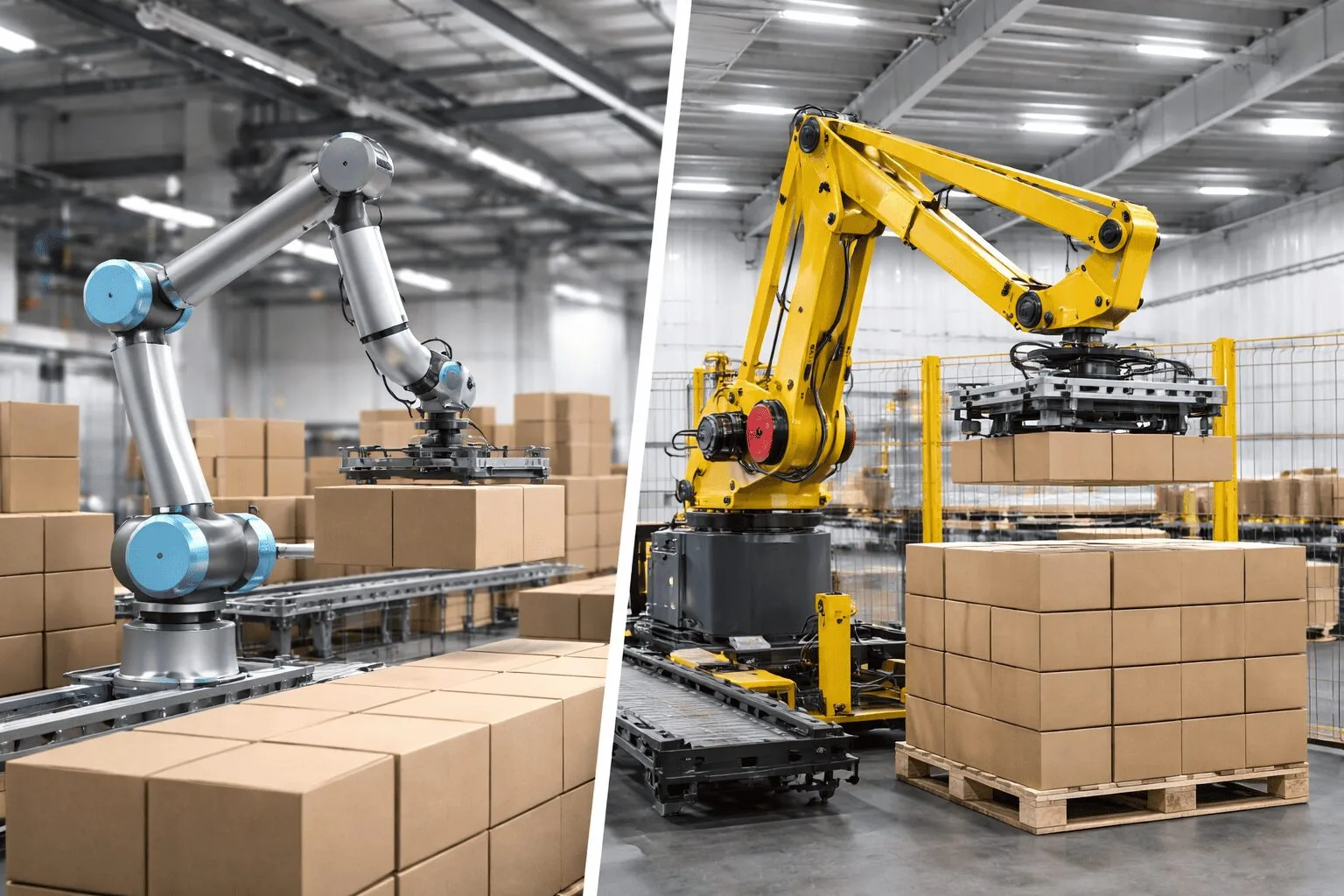
Collaborative robots (cobots) have made this transition easier because they:
- Work safely alongside operators
- Offer high flexibility
- Adapt to different product formats
- Require less space
- Enable gradual automation
They are an ideal solution for companies looking to automate without completely transforming their existing operations.
In many cases, starting with palletizing is the simplest way to introduce automation on the shop floor.
7. Automation is not replacement — it is optimization
Well-implemented palletizing automation:
- Does not eliminate jobs
- Reduces low-value repetitive tasks
- Improves working conditions
- Increases overall efficiency
In most cases, it enables teams to work better — not less.
Comparison table: manual vs automated palletizing
| Aspect | Manual palletizing | Manual palletizing |
|---|---|---|
| Physical effort | High | Very low |
| Risk of injuries | High | Reduced |
| Work pace | Variable | Consistent |
| Errors | Frequent | Minimal |
| Productivity | Limited | Optimized |
| Operator role | Manual handling | Supervision & control |
| Process stability | Medium | High |
Palletizing automation does not replace operators — it supports them.
It transforms physically demanding tasks into safer, more efficient, and more sustainable processes on the shop floor.
If you are considering improving palletizing in your facility, analyzing your current process is the first step to defining a truly efficient solution.
Automation is not about doing less work — it is about working better.
Preguntas frecuentes sobre automatización del paletizado
Does a palletizing robot replace operators?
No. The robot handles repetitive and physically demanding tasks, while operators focus on supervision, control, and higher-value activities.
What are the main benefits of palletizing automation?
Reduced physical strain, fewer errors, improved productivity, and more stable operations.
Is it difficult to integrate a robot into an existing line?
Not necessarily. Many solutions, especially cobots, can be integrated gradually into existing production lines.
Are collaborative robots safe to work with?
Yes. Cobots are designed to work alongside operators and comply with industrial safety standards.
When should a company consider automating palletizing?
When there are repetitive tasks, high physical strain, frequent errors, or a need to improve efficiency on the shop floor.
Do you want to know how to automate palletizing in your line without complicating your operations?
Do you want to know how to automate palletizing in your line without complicating your operations?
Talk to a specialist in end-of-line automation